Declassified field reports from a kid in rural Indiana who hid in a feather bed, set a few small fires, interrogated Santa’s logistics, and grew up to build Smith Maker. Filed under two names: JW, who was supervised, and Jimmy, who was not.
Filer JW Phase Phase 0 · Post 1 Location Kingman, IN — grandparents’ farm
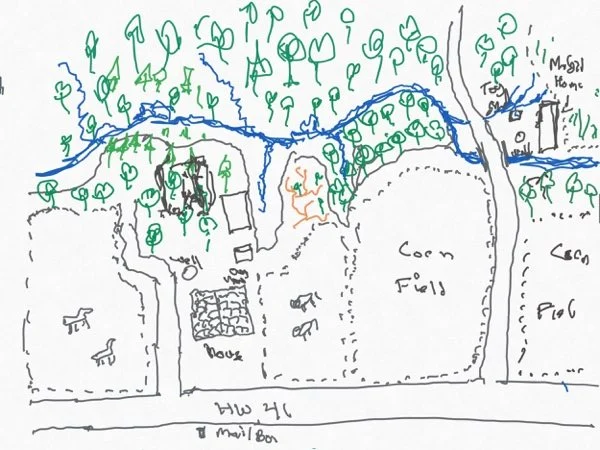
Exhibit — Site Map Hand-drawn map of the Kingman farm: house, barn, creek, woods, and pastures.
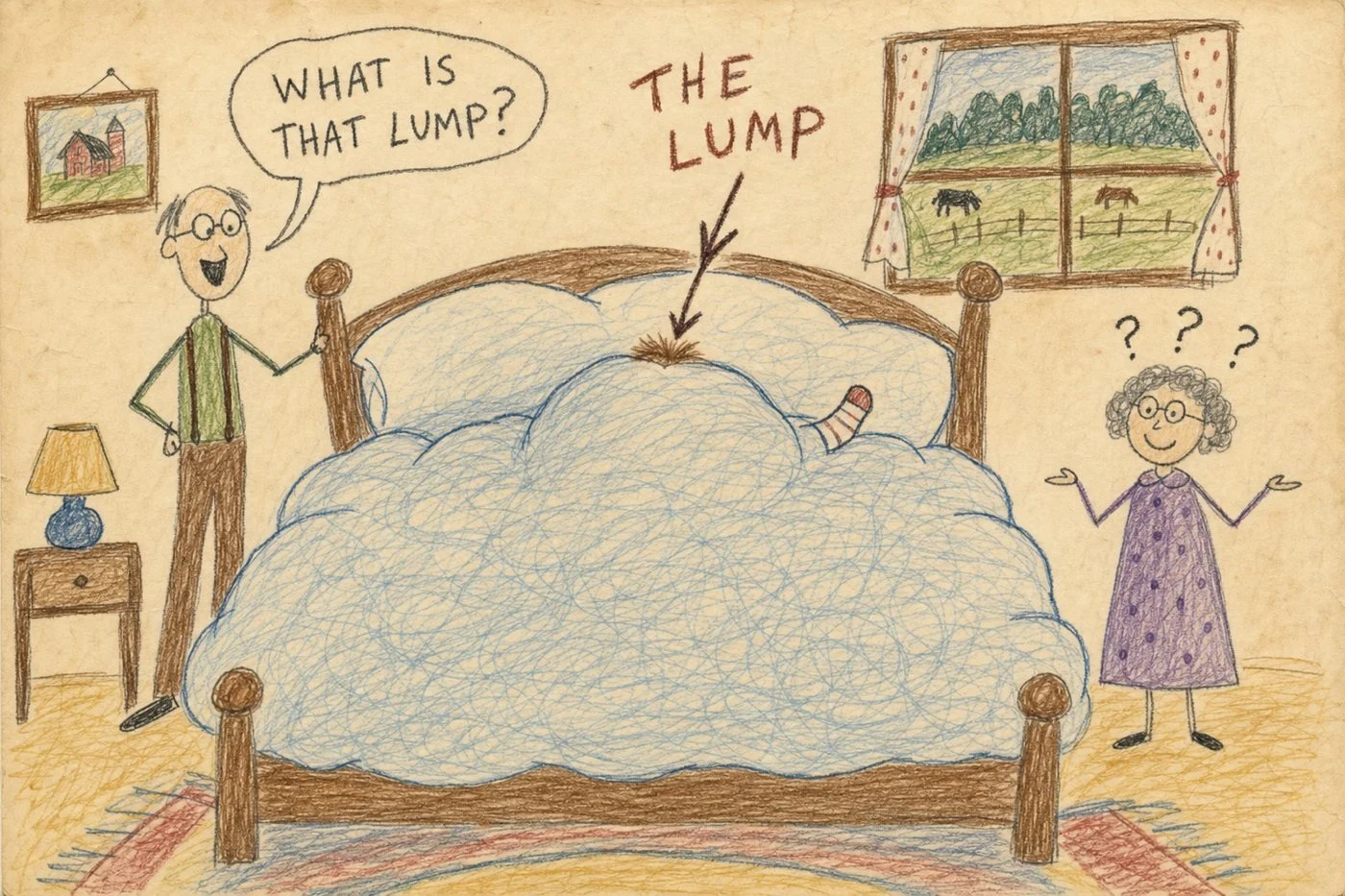
The oldest file in the archive is a feather bed. My grandparents had one—huge, deep, the kind of bed that doesn’t really exist anymore—in a farmhouse in rural Indiana with pastures on both sides and woods out back. And the earliest thing I can remember, the very bottom of the whole stack, is this: crawling under those covers and disappearing.
That bed could swallow a kid whole, and it did. I’d burrow in and hold still. Then Grandpa would come in and ask, in a voice pitched to carry, “What is that lump?” And Grandma would consider the question seriously. “I don’t know. It could be anything.” And the lump would hold perfectly still, vibrating with the effort of not laughing. The most successfully hidden boy in Indiana.
That’s the first memory—not a toy, not a fall, not a fire. Those come later, and there are files on all of them. The first memory is of being small, and warm, and hidden, in the safest place I knew, while two people who loved me pretended not to find me for exactly as long as I wanted to stay lost.
Every operation that follows in this archive—every expedition, every cache, every unauthorized experiment—was run by a kid whose first memory is as a hidden lump in a feather bed.
Lesson LoggedEvery operative needs one place where being found is the game and never the danger. Start your story there. I just did.
More field reports declassified soon. —JW
Jimmy
FIELD REPORT 002
First Recorded Experiment
Filer Jimmy Phase Phase 0 · Post 2 Location Hillsboro, IN — trailer park (gone)
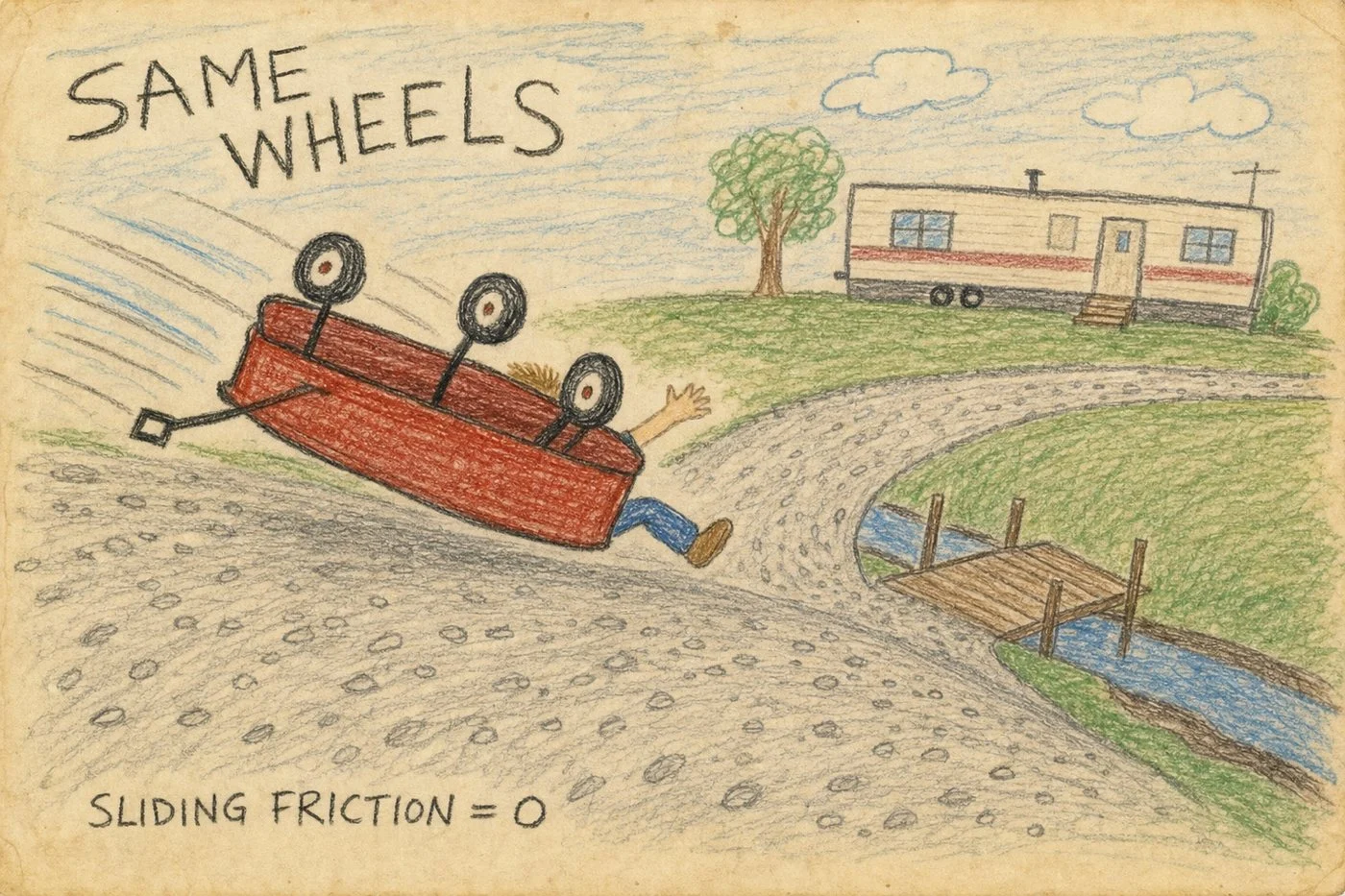
Plate 002 The wagon, the hill, and the discovery of sliding friction.
Every operation has an origin. Mine involves a Hot Wheels trike, a red wagon, and a street built on a downgrade.
The trike could slide. Anyone who had one knew that if you pedaled hard and then cranked the handlebars, the back end would swing around like you’re Bo Duke escaping Rosco. After hundreds of slides, I had the maneuver down to a science.
The wagon, I reasoned, was just a bigger trike. The front wheels were somewhat steerable and roughly the same height as the trike’s. In the absence of pedals, the hill would provide the necessary speed.
With supreme confidence, I positioned the wagon at the top of the hill and then climbed aboard. I grinned as the optimal speed was reached for the maneuver. Then I cranked the handle. Quite unexpectedly, the wagon, now bound by a different law of physics, embraced the pavement, and I experienced temporary weightlessness before the forces of gravity took over again.
What I discovered that day was the coefficient of sliding friction—specifically, that rubber wagon wheels do not have a coefficient low enough to steer/drift in any direction, whereas the trike’s plastic wheels drifted because of their low coefficient.
Lesson LoggedKnowing a thing works is not the same as knowing why it works. I have been chasing the why ever since.
More field reports declassified soon. —Jimmy
BADMAN ENGINEERING STANDARD 001
Toast Orientation
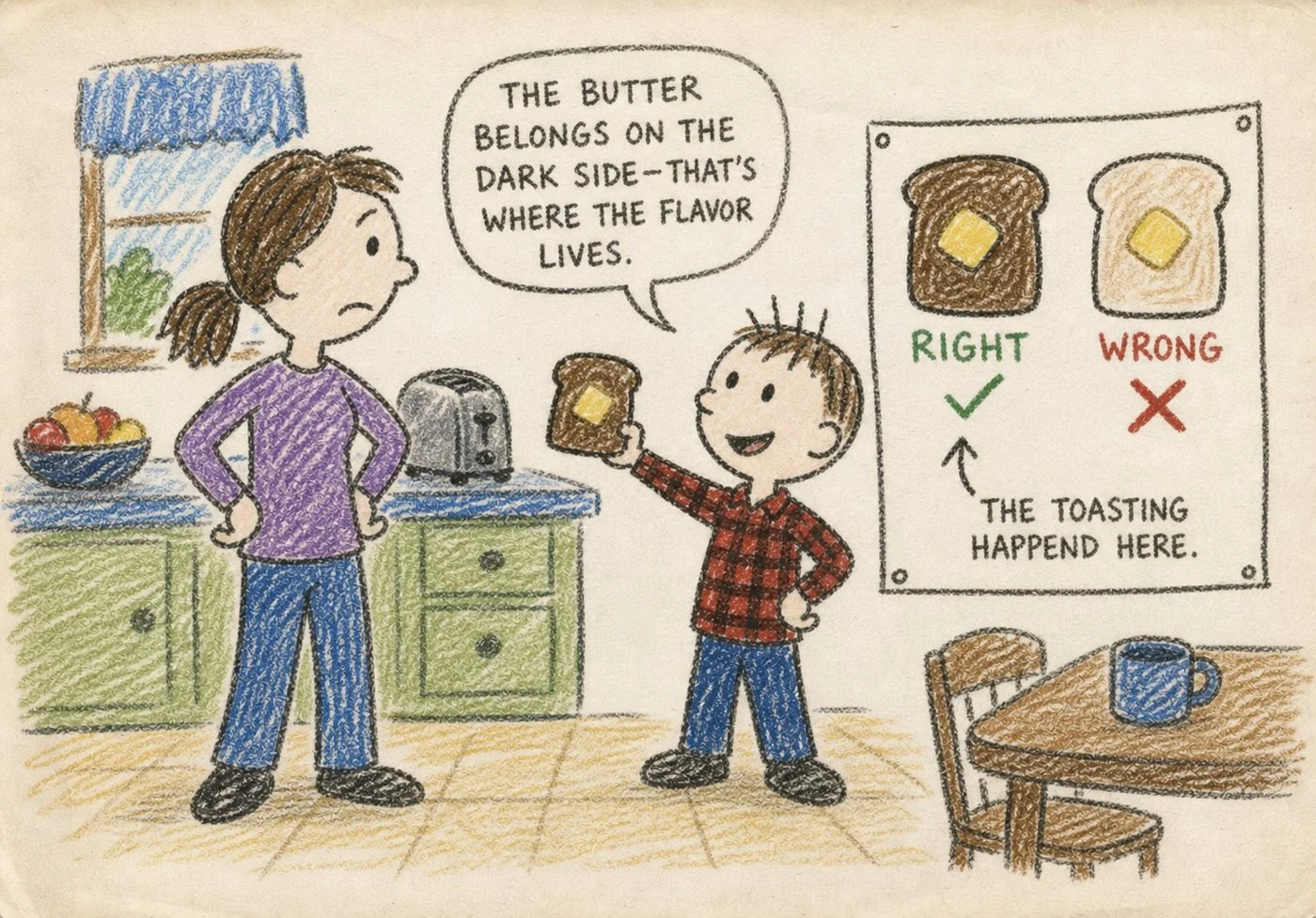
Fig. STD-001 The standard, illustrated. Butter belongs on the dark side.
BadMan Engineering Standard No. 1: Butter shall be applied to the darkest side of the toast.
I do not believe in half measures. If you are going to do something, do it correctly. If you are going to willfully choose to do it the wrong way—or, worse, cannot see the difference—then just step aside and let me do it. My earliest recollection of adopting and enforcing this standard was around age five.
This standard is not a preference. It is clearly the correct way to butter toast. There is no other option. The dark side is where the toasting happened—it is the working surface, the crisp face, the side that earned the butter. The butter softens the crispness. It evens out the two sides. Buttering the pale side wastes the entire point of the operation. Buttering the pale side is wrong.
I presented this standard to my mother repeatedly throughout my childhood. She never adopted it. To be fair, she was very busy putting out my fires—literally, see forthcoming reports—but the standard stood then and still stands now.
After five decades, the adoption rate for BadMan Engineering Standard No. 1 is still one. However, the standard does not require consensus. It only requires that it be correct.
Submit competing standards at your own risk.
Jimmy
FIELD REPORT 003
The Sleigh Track Investigation
Filer Jimmy Phase Phase 0 · Post 3 Location Covington, IN
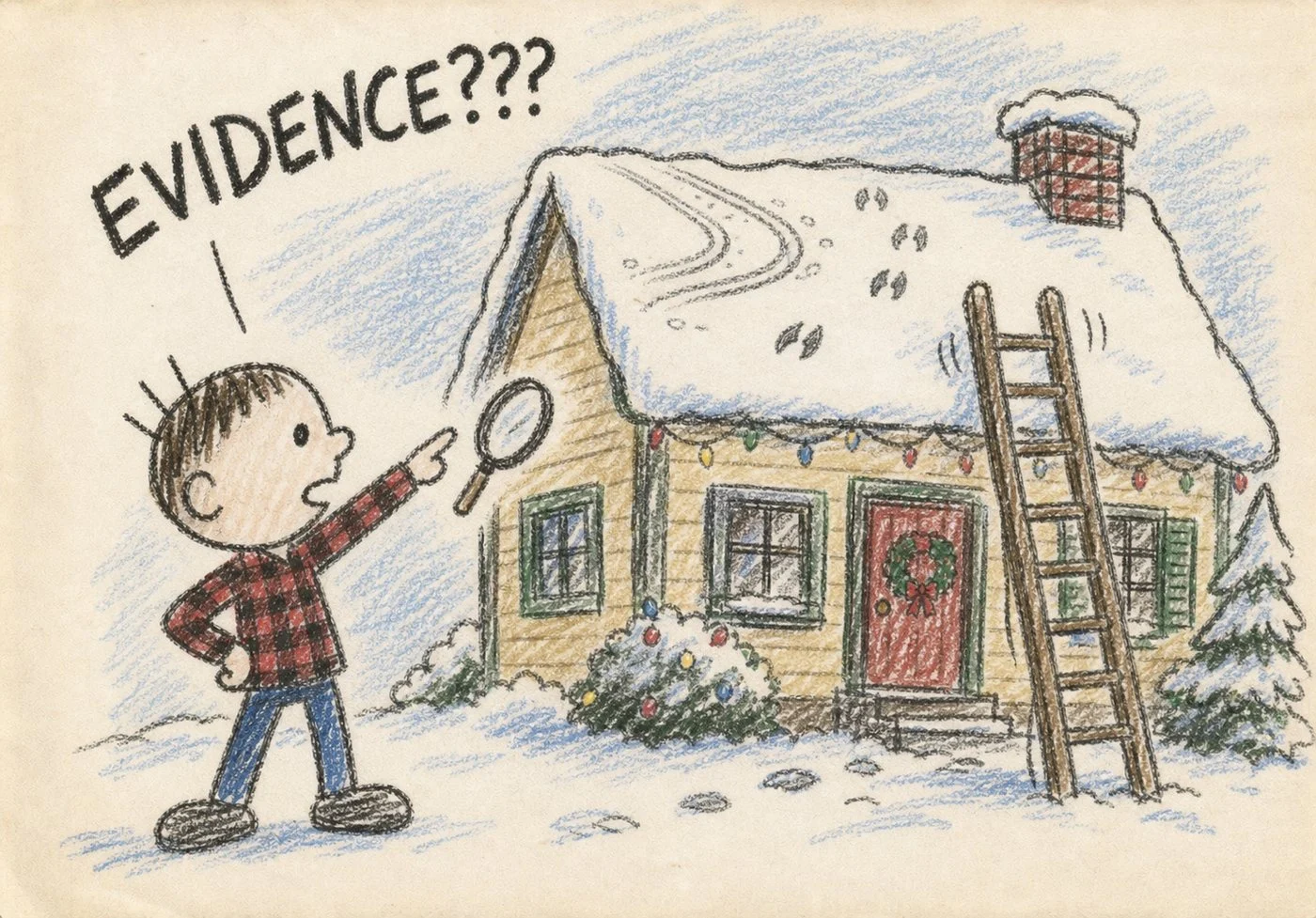
Plate 003 Requesting a ladder. For evidence.
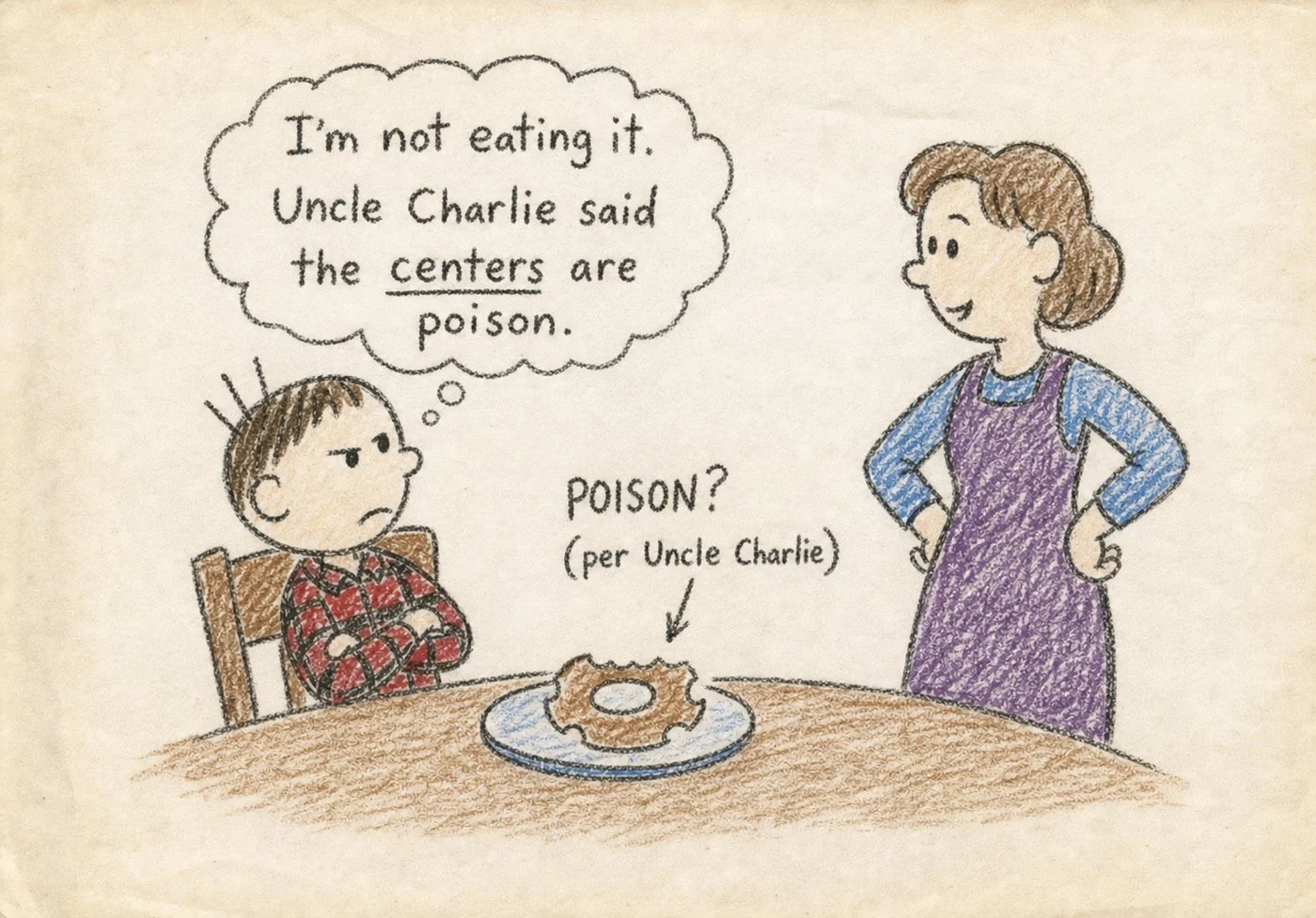
By kindergarten, I had begun noticing that adult-supplied data did not always survive verification. Uncle Charlie had already told me that donut centers are poison—hence why they are removed. He seemed like a reliable source at the time, and so I had been leaving a little ring around every donut hole for years. However, the skeptic in me was awakening.
That Christmas, I did not ask for a toy. I asked for a ladder. The logic was sound: if Santa’s sleigh were real, there would be tracks on the roof. Physical evidence. All I needed was access to the inspection site.
I did not get the ladder. Make of that what you will.
The donut hole audit continued.
Lesson LoggedA claim is not golden until you can prove it. I have been asking for the ladder ever since.
More field reports declassified soon. —Jimmy
FROM THE BADMAN MEDICAL DICTIONARY
Uncle Charlie Syndrome
Fig. DX The donut ring. The poison was never there.
Uncle Charlie Syndrome(n.) — a condition in which the first information a person receives on a subject shapes a narrative so durable that no amount of later evidence can fully dislodge it.
My late Uncle Charlie informed me at a young age that donut centers are poison. That is why they cut them out. He seemed like a reliable source at the time, and so I believed him for years. My solution was to leave a ring of donut around the center hole, just in case some of the poison remained.
Long after I should have known better, I still left a donut ring around the hole of every donut that I ate. The facts had updated, but the narrative had not.
That is Uncle Charlie Syndrome. The first data in builds the foundation, and everything after gets bent to fit the foundation rather than the other way around. There is no cure, only management. Assume your earliest information on any subject was supplied by an Uncle Charlie and audit accordingly.
Diagnostic question: What is your donut ring? Everybody’s got one.
Filed under field notes.
Jimmy
FIELD REPORT 004
The Flight Worthiness Test
Filer Jimmy Phase Phase 1 · Post 4 Location Hillsboro, IN — same hill as the wagon
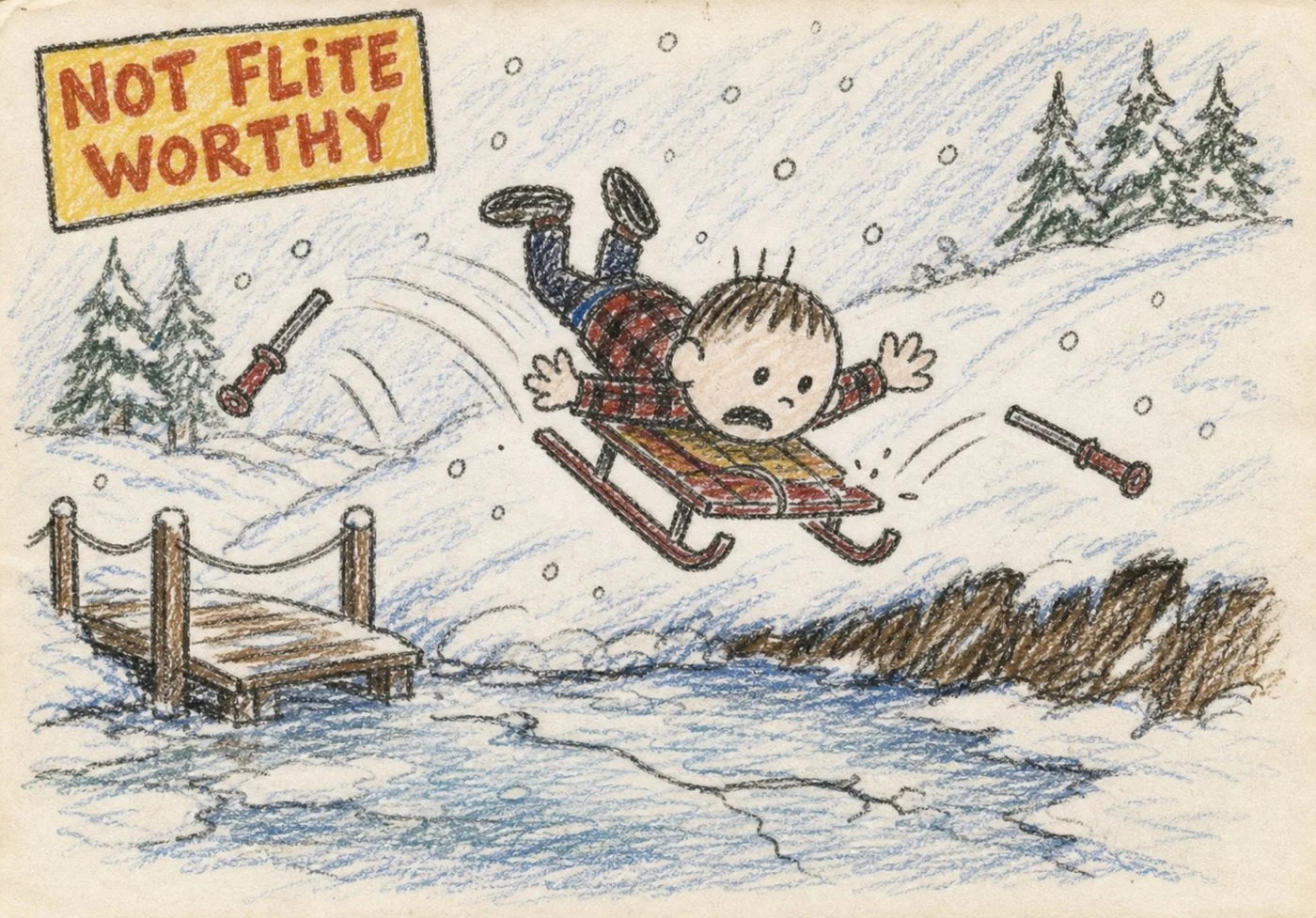
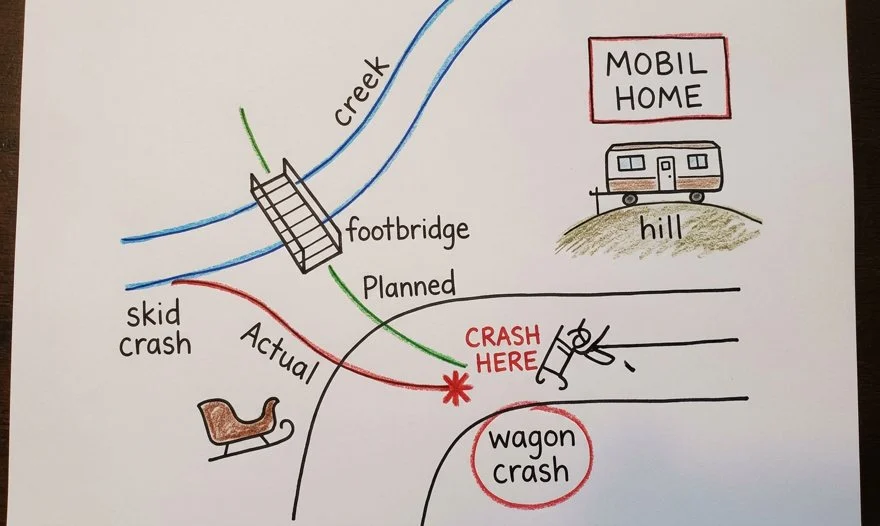
Plate 004 The rail sled, mid–unscheduled flight worthiness test. Exhibit — Incident Map Planned route vs. actual. Annotated: “CRASH HERE.”
In rural Indiana, a healthy snowfall often resulted in the most glorious of school holidays—a snow day! On one such occasion, I devised a new experiment.
First, understand that I had done my calculations. That winter, the hill had been a working laboratory, and I had studied it: the older kids snow skitching behind anything that moved, somebody riding on a detached car hood while being towed, and kids on their plastic sleds pointing themselves downhill and then bailing off into the snow before the turn at the bottom. That last part struck me as a design flaw, not a maneuver. A plastic sled has no rudder—bailing is its steering.
At this point, I should add that there was a valid reason for bailing before the turn. If you continued straight, you would end up in a frozen creek with rather steep banks. There was, however, a footbridge off to the right that traversed this complication.
I believed that I had one advantage over the plastic sledders. I had a rail sled with runners and a steering bar. It was a proper vehicle with actual controls. I reasoned, with the airtight confidence of a boy who had never yet been wrong, that bailing was for people without better options. I would not bail. I would ride it down, make the 45-degree turn at the bottom, and cross the footbridge like a gentleman. I had run the calculation in my head. The calculation was optimistic.
Once again, I positioned myself at the top of the hill, climbed aboard my chosen vehicle, and launched myself down the hill. The plan had exactly one weakness—the plan itself. Halfway through the turn, the data came in: I am not going to make it. So I made the only command decision available. I cut back hard and initiated an unscheduled flight worthiness test.
I picked my creek entry point, left the bank clean, and stuck the landing in the sense that the landing occurred. Both handles snapped off the sled, but the pilot walked away. The findings were conclusive: the sled was not flight worthy.
Then came the most important phase of the operation: I got the sled home and stashed it before anyone could conduct an inspection.
Lesson Logged(1) Decide your abort plan before launch, not in the middle of the turn. And (2), which took decades longer to unlearn: when you hide a broken sled, nobody can help you fix it.
More field reports declassified soon. —Jimmy
Jimmy
FIELD REPORT 005
Procurement Runs
Filer Jimmy Phase Phase 1 · Post 5 Location rural Indiana — junkyard
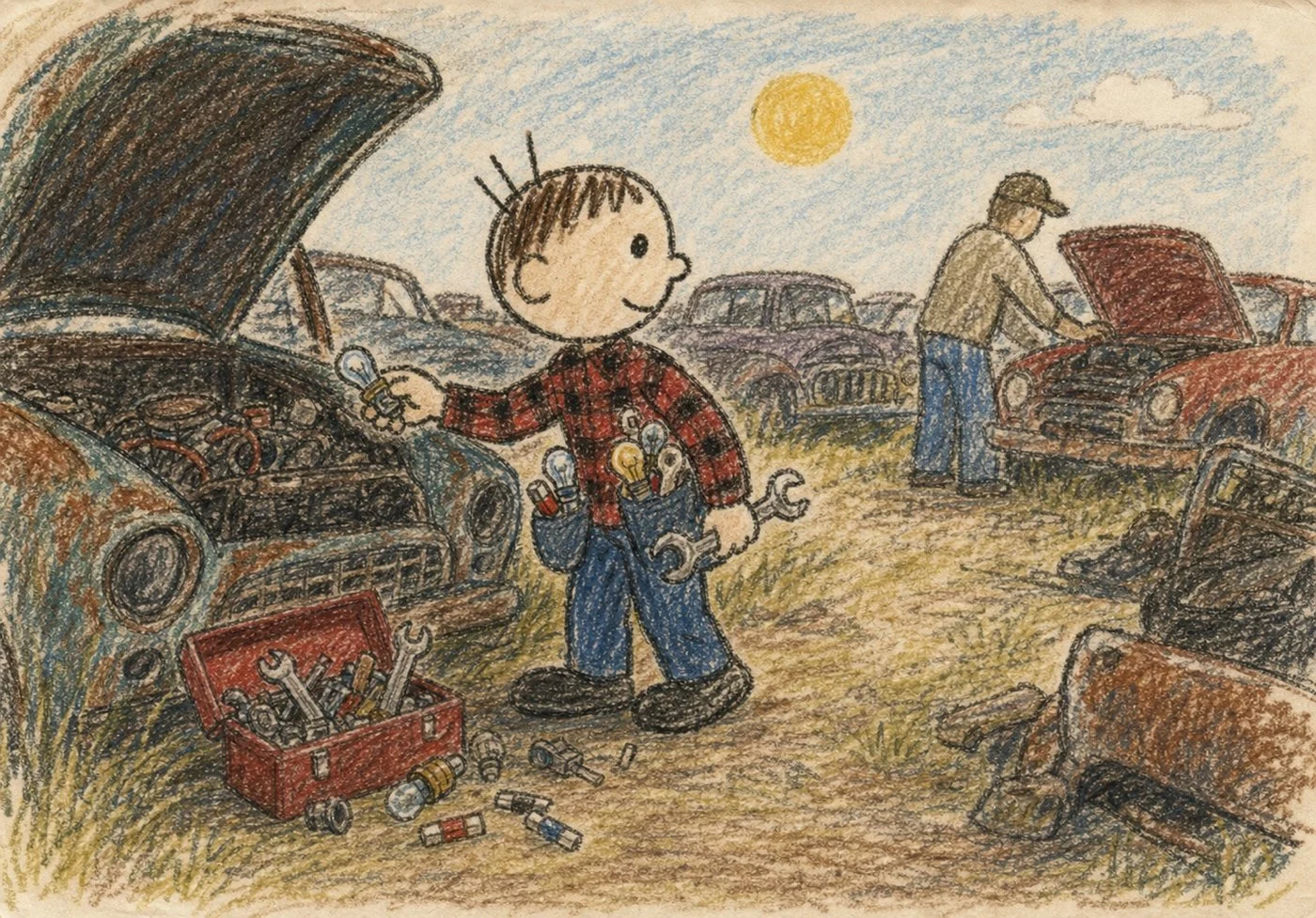
Plate 005 A kid loose in a field of dead machines, with wrenches.
Some of my best days were junkyard days. Dad’s car always needed something, and the junkyard was where you got it. He’d find the donor vehicle and get to work, and here is the part that mattered: he’d let me take parts off myself. Real tools. Real bolts. I was a kid loose in a field of dead machines with wrenches.
I had my assignments, but I also had my own procurement program running on the side. Every glove box held a small light bulb. Every fuse panel was full of fuses. No one else wanted them, and I pulled them like found treasure and stashed them in a bin under my bed—because you never know what you might need for a project.
I didn’t have a project. The parts came first. The project would reveal itself.
That was the whole education, really. Dad could fix anything—everyone said so—and what he taught me was that broken machines are just parts that haven’t been reassigned yet. The difference between junk and inventory is whether somebody bothered to pull it and keep it.
I still stock the bin before I know the build. The bin has never once let me down.
Lesson LoggedMaintain your parts inventory. The project will tell you what it needs; your job is to already have it.
More field reports declassified soon. —Jimmy
The Management
QUICK BRIEF
What Is Smith Maker?
Filer The Management
You have been reading the field notes of a kid from rural Indiana. Here is what that kid eventually built.
Smith Maker is a line of resources for organizing and running a print shop or, as we prefer to frame it around here, a headquarters for the aspiring supervillain. Labels, organizers, systems, etc.—these all figure into the unglamorous infrastructure that decides whether your headquarters runs like a monument to logistics or like a junk drawer with ambition.
What makes Smith Maker products—called Smithibles—different is that they are not drawn manually. Smithibles are generated. Every product comes out of a governed pipeline, which means every label in a set is consistent with every other label, every variant is reproducible, and the files themselves know what they are. Smithibles carry their own documentation inside themselves, like an object that remembers its own DNA.
But you don’t have to take my word for any of this yet. The products work whether or not you care how they are made. But if you do care, you’re my kind of people, and there will be much more on this.
Every Smith Maker product ships with documentation written the way I wish all documentation was written: the known issues first (because you’d rather hear about the camera calibration before you cut, not after), then the 90-second brief for the manager who needs to be somewhere, then the full detail for those who stayed after the briefing. Sprinkled throughout, BadMan Field Notes provide off-the-wall operational advice that was earned the hard way. (For example, when your spouse reports faulty equipment, do not ask whether it is plugged in. Rather, suggest unplugging it and plugging it back in. Same diagnostic, vastly different evening.)
The kid whose field notes you’ve been reading filled his pockets with glove box bulbs and fuses because he never knew what a project might need. This is what the project turned out to be.
Welcome to headquarters.
Jimmy
FIELD REPORT 006
The Materials Research Incident
Filer Jimmy Phase Phase 2 · Post 6 Location Hillsboro, IN — swinging bridge trailer park
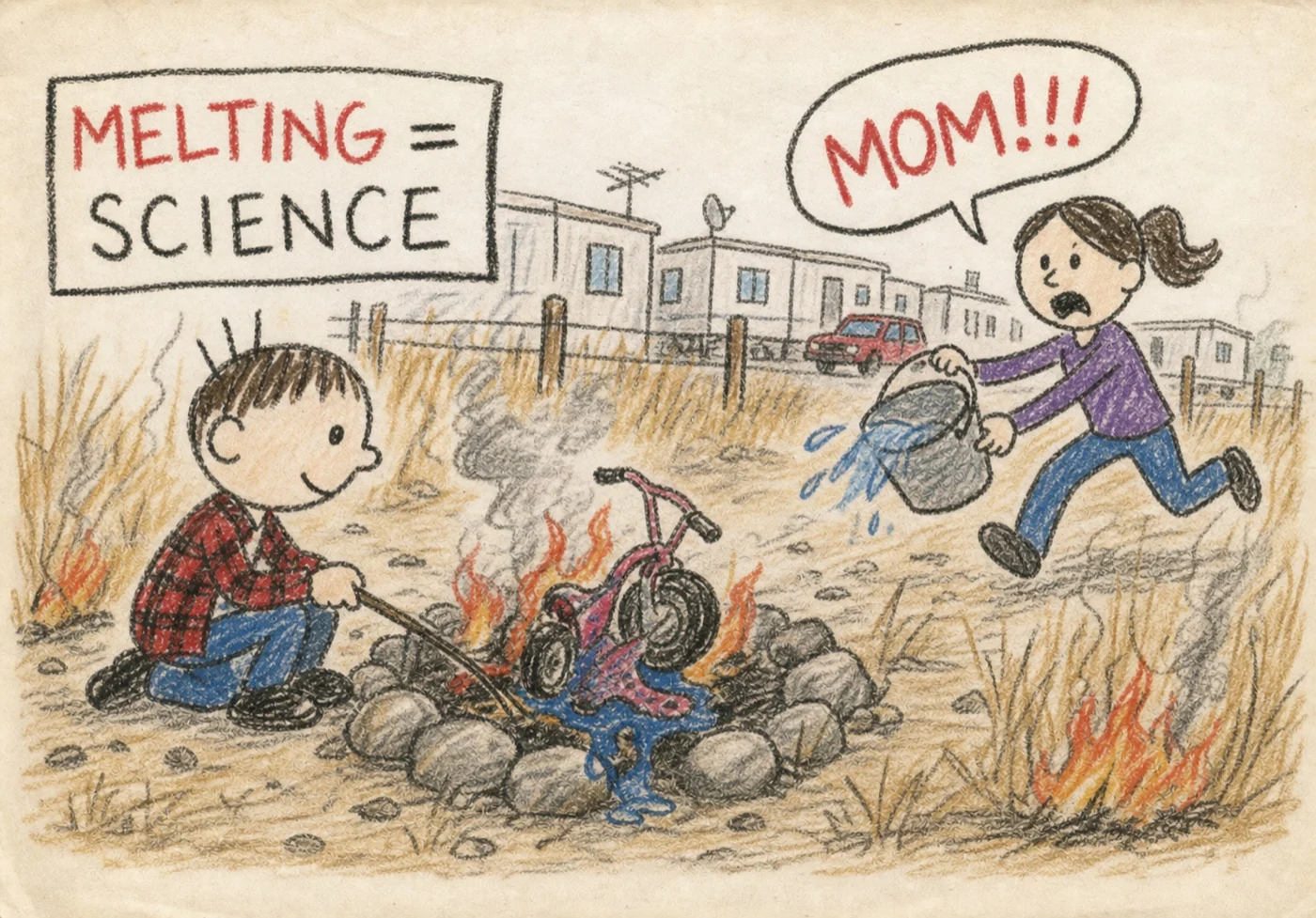
Plate 006 Melting = science. The escalation path had more water than I did.
We lived in a trailer park next to a grassy path that served as the unofficial dump. People burned their trash there, in a big rocky pit, and one day somebody left theirs burning unattended.
To a first grader, an unattended fire is not a hazard. It's a laboratory.
I had parts of a Hot Wheels trike and a research question: What does plastic do when it melts? Answer: It drips, it strings, and it behaves fascinatingly when applied to dead horseweed. I was deep in the data collection phase. Peer review was not present.
What I failed to monitor was the test perimeter. At some point, I looked up and discovered that I was running multiple uncontrolled burns. My remediation efforts were not working. The fires had scaled past my equipment.
So I executed the most important protocol I knew: I ran and got Mom.
She was maybe 30 feet away, and she was fast—buckets of water, stomping, the whole response package deployed before I'd finished explaining. The fires died. I did not even get in any real trouble, though I can still see something move behind her eyes when this one comes up at family lore sessions.
Lesson LoggedEvery operation needs an escalation path to someone with more water than you. Knowing when to pull that cord isn't failure; it's the only reason I am here to file this report.
More field reports declassified soon. —Jimmy
JW
FIELD REPORT 007
The Creek Supply Chain
Filer JW Phase Phase 2 · Post 7 Location Kingman, IN — grandparents’ farm
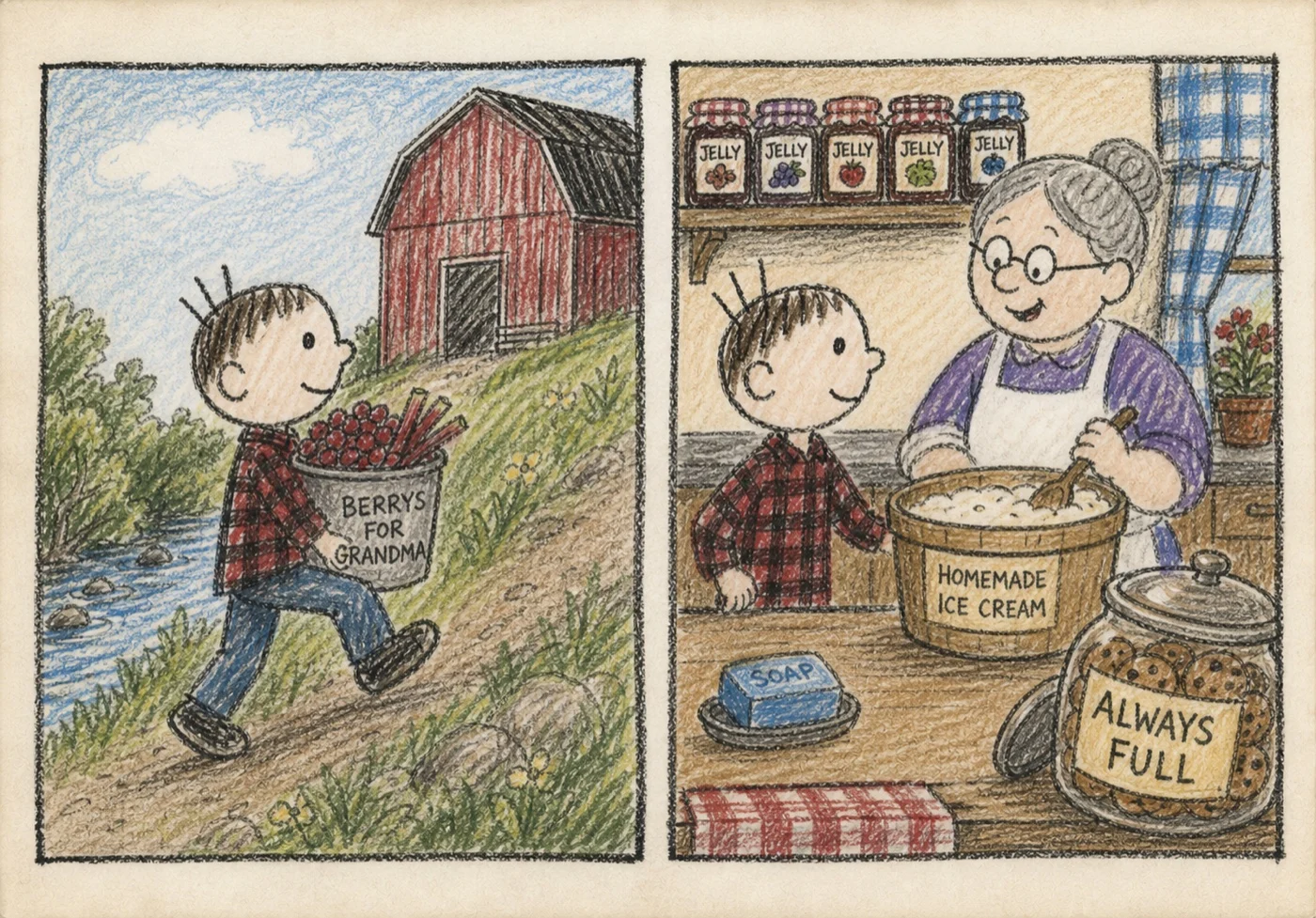
Plate 007 The supply chain: creek to kitchen to jar. Proof on the shelf.
Down the hill and behind the barn at my grandparents' farm, there ran a creek, and the creek was where I did my best work.
I knew that territory like a contractor knows his worksite: where the gooseberries grew, where the raspberries came in, and where the rhubarb stood. I'd work the creek line and come back up the hill with whatever the season was offering and delivered the haul to Grandma.
This was not charity on my part. This was a supply agreement. I provided raw materials; she ran the processing operation. And what an operation it was! Berries and rhubarb went into her kitchen whole and came out the other side as jelly, jars of it, which was then labeled and shelved. The same kitchen also produced homemade ice cream and soap. I brought up the gathered chaos of a creek bank, and Grandma turned it into finished goods. The jars on the shelf were proof that the whole pipeline worked.
And then there was the cookie jar. I want to contrast this operation with my other grandmother's facility, where baked goods were counted, allocated, and defended. (A report on that incident is coming, and I do not emerge from it well.) This grandma's cookie jar ran a different policy entirely: it was always full, and it was always open. No audit. No interrogation. You walked past, you lifted the lid, and you took a cookie. The jar simply restocked itself through some mechanism I never investigated, because some systems you don't question—you just make sure you're inside them.
Lesson LoggedThe best pipelines have a trusted operator at every stage and proof on the shelf when they're done. The best inventory policy I ever encountered was a jar that asked nothing and was never empty.
More field reports declassified soon. —JW
Jimmy
FIELD REPORT 008
The Lost Labels
Filer Jimmy Phase Phase 2 · Post 8 Location Covington, IN
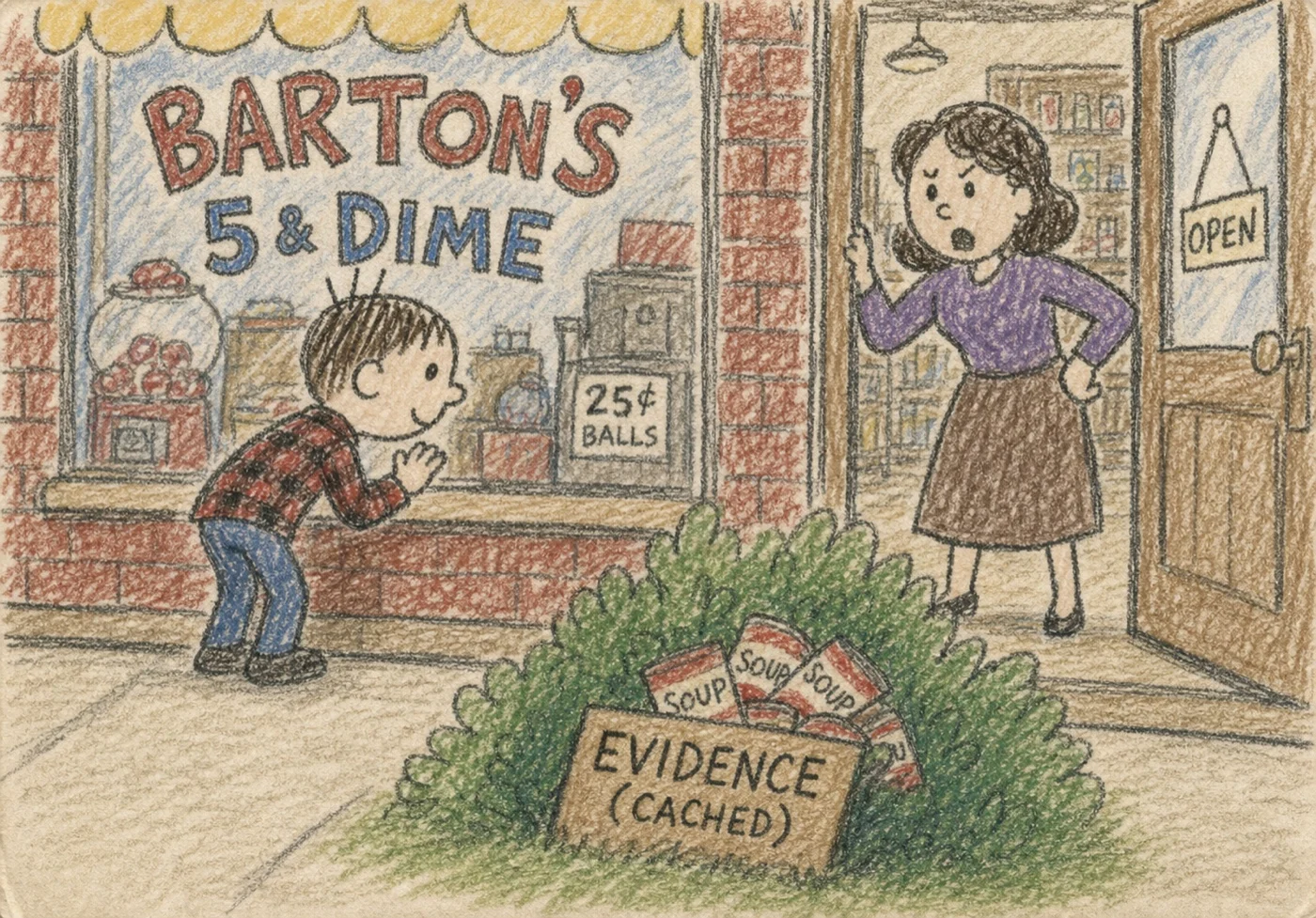
Plate 008 An unsecured cache is a donation with extra steps.
In first grade, I walked to school—a kid-sized commute of a couple of blocks. Mom would walk me partway and then watch from the edge of our block while I covered the last stretch. She believed this constituted supervision, but I understood it to be a surveillance window with a known blind spot. The moment she turned back toward the house, I executed my procedure: an opposite turn away from school and toward the five-and-dime.
On one particular day, I was carrying Campbell's soup labels. The school collected them—labels for points, points for equipment, or something like that—and I had a stack, which was now a liability. A kid window-shopping the five-and-dime with a fistful of soup labels is a kid with evidence of truancy. So I did what any operator with cache experience would do: I stashed the labels in a bush for later recovery, and off I went to conduct my unauthorized retail reconnaissance.
My mother met me coming out of the store. I want the record to reflect her detection rate across this entire archive: the woman missed nothing that mattered for longer than an afternoon.
But here's the part that has genuinely never stopped bothering me: the labels were never recovered. I went back to that spot, more than once, and searched that bush like it owed me money. The labels were simply gone! My first label inventory, cached in an unsecured location, was lost forever to causes unknown.
Perhaps unsurprisingly, I have since spent a rather significant portion of my adult life making labels, registering them, check summing them, and storing them where bushes cannot get them. I am not saying these facts are connected. I am saying I have never once lost a label since, and I know exactly which bush to blame.
Lesson LoggedAn unsecured cache is a donation with extra steps. If it matters, register it, store it properly, and know where it is—or accept that the bush owns it now.
More field reports declassified soon. —Jimmy
Jimmy
FIELD REPORT 009
The Grid Incident
Filer Jimmy Phase Phase 2 · Post 9 Location Cayuga, IN
Plate 009 You can hide the adapter. You cannot hide the outage.
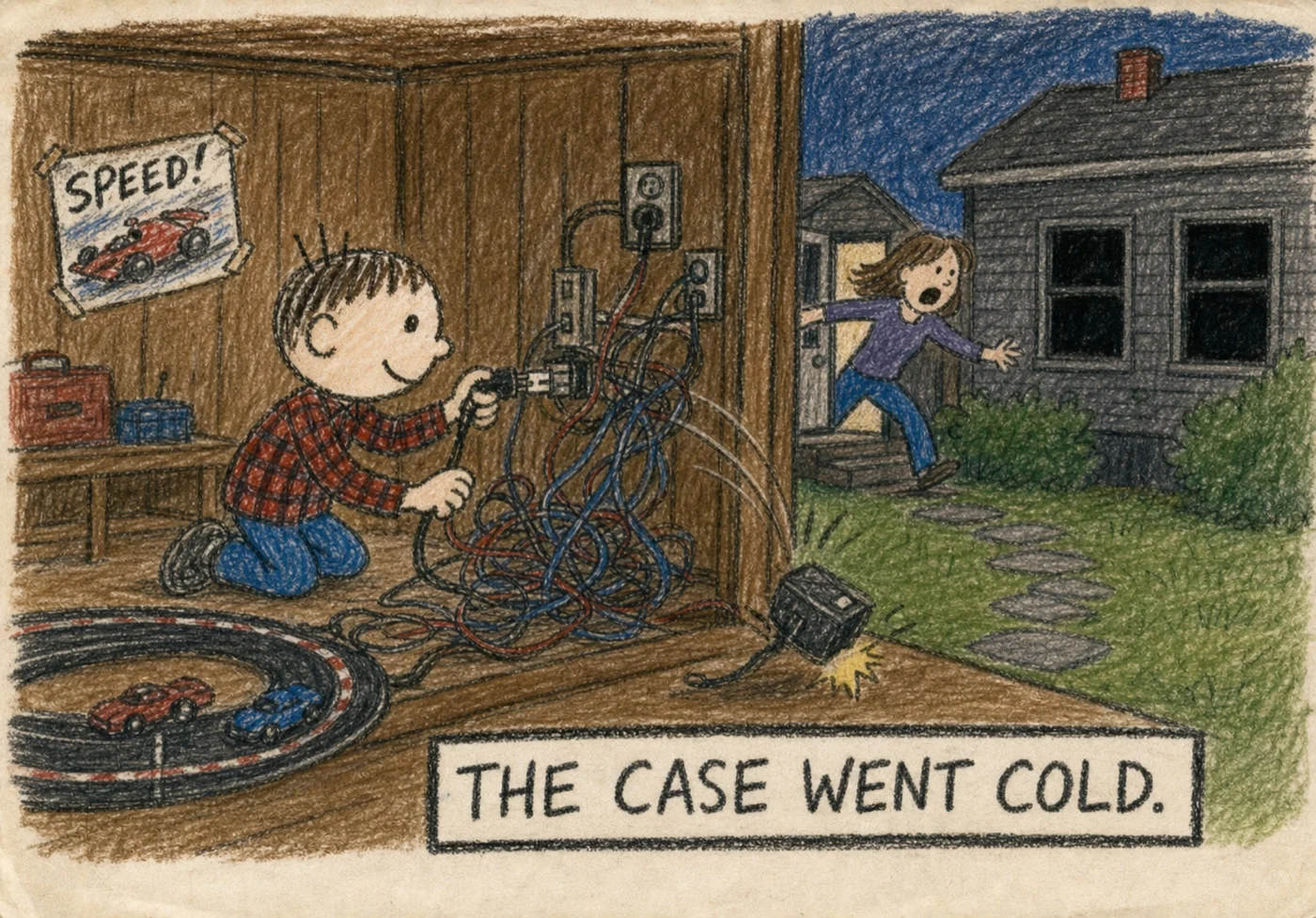
During second grade, the house we lived in had a shed out back, which meant I had a facility. I was out there one afternoon when I decided it was time to wire something up. I had materials. I had ambition. And, critically, I had a power supply, the adapter from my racetrack, which I reasoned was a perfectly legitimate source of electricity for projects beyond its stated mission.
I made my connections. I plugged it in. And the lights went out.
What happened next is a matter of timing. Somewhere in the house, my mother detected the grid failure and was out the door in seconds. I'm telling you, this woman's response time should have been studied. As she covered the gap between the door and the shed, I executed the only protocol I had to save myself: the adapter was unplugged and chucked into the corner, and the investigator was greeted by the innocent face of a child who was simply playing when the universe mysteriously failed.
As Mom checked things out, the evidence sat in the corner, still warm. The case, however, soon went cold.
Lesson LoggedDo not run untested experiments on production infrastructure. The whole household shares that circuit, and the blackout is the audit trail. You can hide the adapter. You cannot hide the outage.